 TM
TM
An automated intelligence pipeline that monitors
regulatory actions, scientific research, and news to identify
emerging personal injury opportunities for the firm.
The Schenk Law Firm, LLP
The Challenge
Too much signal,
not enough time
Every week, hundreds of product recalls, adverse event reports,
medical studies, and investigative reports publish across dozens
of sources. By the time a firm manually spots a pattern,
competitors have already launched campaigns.
Tort Scanner automates this entire workflow, from raw data
to attorney-ready reports, three times per week.
How It Works
Five-Stage Pipeline
01
Collect
Pull from
all sources
02
Filter
AI scores
each item
03
Research
Deep dive on
top topics
04
Draft
Memo +
landing page
05
Deliver
Google Drive
+ Tracker
Fully automated. No manual intervention required.
Stage 01
Collect
Monitors regulatory agencies, medical databases, and investigative
journalism outlets via RSS feeds and APIs.
FDA Recalls
Product recalls and safety alerts from the Food and Drug Administration
CPSC Recalls
Consumer Product Safety Commission recall notices and hazard reports
PubMed
Medical research on adverse effects, product injuries, and toxic exposure
ProPublica
Investigative journalism on corporate accountability and consumer harm
The Markup / 404 Media
Tech accountability, AI harms, platform negligence reporting
Ars Technica / EFF
Tech policy coverage, digital rights, and emerging technology risks
Stage 02
Filter
AI evaluates every collected item against weighted criteria
tailored to the firm's practice areas. Each item is scored 1 to 10.
Priority areas (digital harms, AI injuries) receive a scoring bonus.
Set to "aggressive" to flag pre-litigation opportunities.
Stage 03
Research
Top-scoring opportunities receive deep research across six areas.
All source URLs are validated before inclusion in the report.
Scientific Evidence
Published studies, FDA adverse events, CPSC complaints
Existing Litigation
Filed lawsuits, MDLs, class actions, JPML motions
Defendant Analysis
Solvency, market position, corporate signals, SEC filings
Plaintiff Population
Affected population size, demographics, reachability
Competitive Landscape
Existing firm campaigns, SEO saturation assessment
Legal Theory
Strongest theories, precedents, statutes of limitation
Stage 04
Draft
Two deliverables per topic
- Research Memo: Executive summary, scored recommendation, evidence review, litigation landscape, defendant and plaintiff analysis, risk assessment, consolidated sources
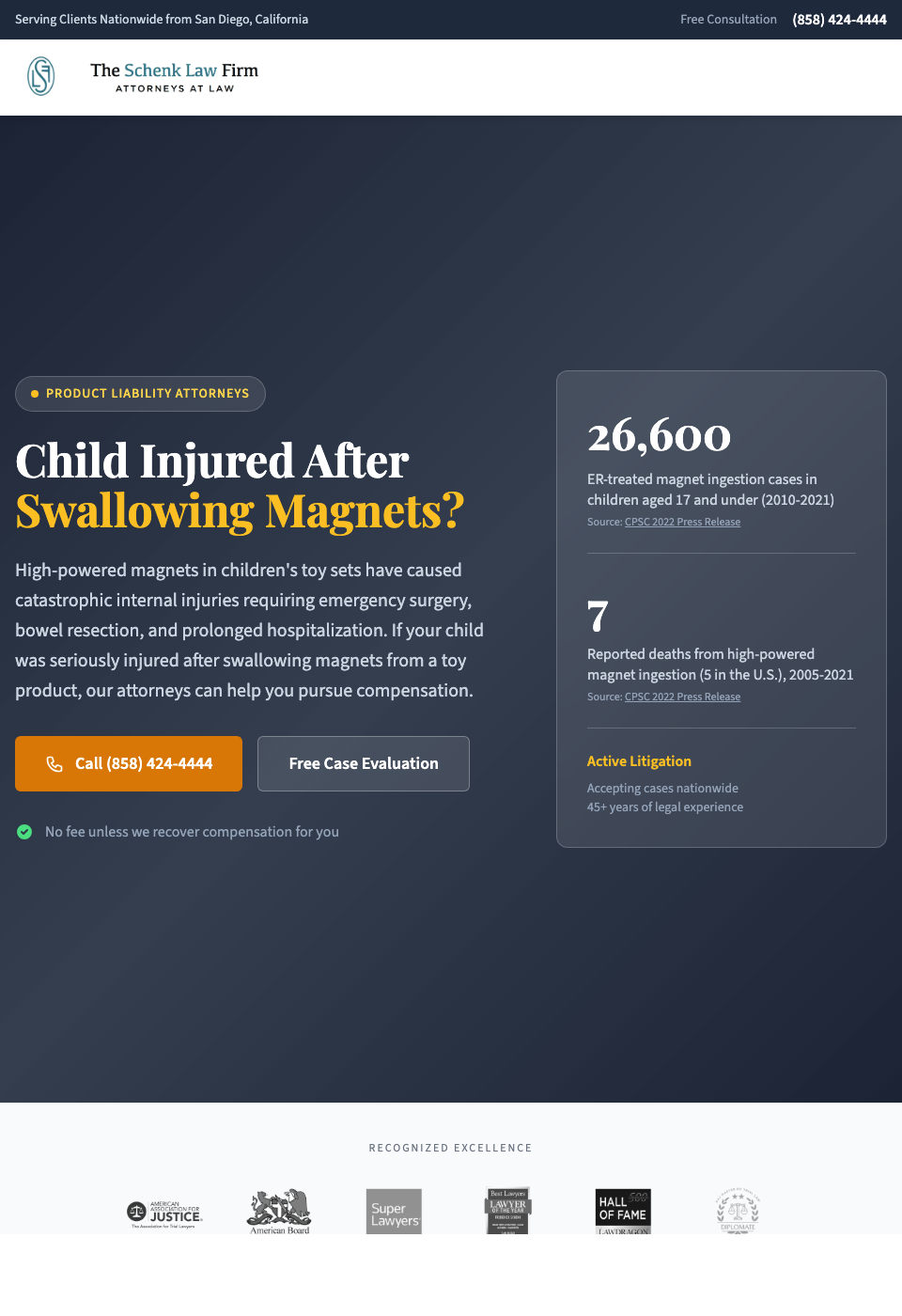
- Landing Page: Production-ready HTML with hero section, sourced statistics, legal theories, FAQ, firm CTA, and attorney advertising disclaimers
- PDF Reports: Formatted research report and landing page draft as printable PDFs for offline review
- Link Validation: Every URL is verified before the report is finalized. Dead links are automatically removed.
Stage 05
Deliver
Reports are organized by date and uploaded to a shared Google Drive.
Each topic gets its own folder with all deliverables.
Tort Scanner Output
2026-02-20
01-button-cell-battery-ingestion
research-memo.md
landing-page.html
research-report.pdf
competitive-analysis.md
sources.md
02-adult-portable-bed-rails
...
daily-summary.md
Tort Scanner Tracker
Continuous Improvement
Feedback Loop
The tracker spreadsheet creates a feedback loop. Rankings from
previous runs calibrate future scoring, so the system learns
what the firm values over time.
01
AI Filter
Reads past rankings to adjust scoring thresholds
02
Tracker Sheet
Topics logged with score and blank ranking columns
03
Attorney Review
Ranks topics as great, good, bad, or irrelevant
Rankings feed back into the next run
Sample Run: February 20, 2026
185 items scanned. 8 opportunities identified.
| Score | Topic | Category |
|---|
| 8.8 |
Button Cell Battery Ingestion: Child Deaths |
Product Liability |
| 8.7 |
Adult Portable Bed Rails: Entrapment Deaths |
Product Liability |
| 8.7 |
Spa Entanglement and Drowning Deaths |
Product Liability |
| 8.6 |
Dresser Tip-Over Deaths and Crushing Injuries |
Product Liability |
| 8.6 |
High-Powered Magnet Ingestion in Children |
Product Liability |
| 7.6 |
Firefighter PFAS Exposure in Protective Gear |
Toxic Exposure |
| 7.4 |
Dating App Sexual Assault Facilitation |
Tech Liability |
| 7.3 |
ChatGPT-Induced Psychotic Episodes |
AI / Emerging Tech |
Runs Monday, Wednesday, Friday
Fully automated. Reports appear in the shared Drive by morning.
Sources: FDA, CPSC, PubMed, ProPublica, The Markup, 404 Media, Ars Technica, EFF
Output: Research memos, landing pages (HTML + PDF), source lists, competitive analysis
Delivery: Shared Google Drive + Tracker Spreadsheet with feedback loop